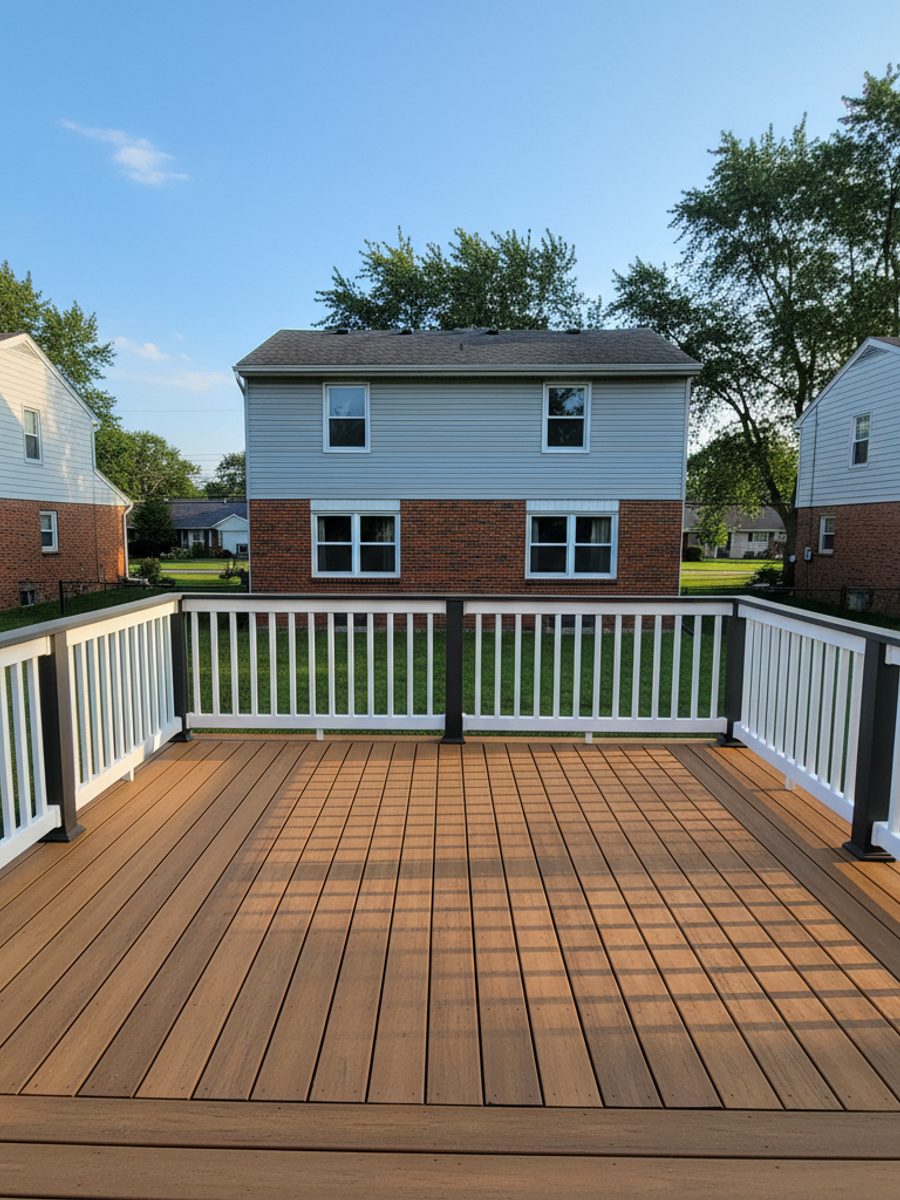
Most people shopping for a deck builder in Pekin are comparing three or four quotes that all sound about the same on paper. Same square footage, similar wood, similar price range. What actually separates them shows up underground, in the permit file, and in what happens the first winter after the deck goes up. Here's what to actually look at.
Tazewell County clay soil is part of the reason this matters more here than it might somewhere with sandy ground. Clay holds water in spring, then shrinks hard when it dries out in July and August. A footing that isn't set deep enough will shift with that cycle, and a deck that felt solid in October can start racking or the stairs can pull away from the landing by the second spring. Anyone who's poured footings in this county for a while knows to plan around that, not react to it later.
What the ground here does to a deck
Central Illinois frost depth runs around 42 inches, and Pekin's building code follows that for anything load-bearing. A deck footing that stops at 24 or 30 inches because it was easier to dig might hold for a season or two, then heave when the ground freezes and pushes it back up. You'll see it as a post that's suddenly an inch higher than the others, or a beam that's gone slightly out of level. Ask any builder how deep they're setting footings and what diameter sonotube they're using. If the answer is vague, or if they say it depends on what the inspector wants that week, that's not confidence, that's guessing.
Older neighborhoods near downtown Pekin often have decks tied into houses built in the 1950s and 60s, where the original ledger board attachment might be nothing more than a few nails and no flashing at all. Newer builds out toward the edges of town, and in towns like East Peoria and Creve Coeur, tend to have better original construction but the same clay underneath. Either way, the soil doesn't care how old the house is.
The permit step nobody wants to slow down for
Decks attached to the house, and most freestanding decks over a certain height, need a building permit through the City of Pekin, or through Tazewell County if you're outside city limits. That means a plan review, a footing inspection before you pour concrete, and a framing inspection before the decking boards go down and cover everything up. A builder who tells you permits are a waste of time, or that they'll just handle it under the radar, is telling you they don't want an inspector checking their footing depth or their ledger flashing. That should worry you more than the permit fee does.
If your lot is close to a property line, a setback check matters too. Pekin has plenty of older lots, especially near the river, where the original survey markers are long gone and the fence line isn't actually the property line. A builder who pulls a real permit will deal with that before pouring concrete instead of after the neighbor complains.
Materials, and what actually survives around here
Pressure-treated pine is still the most common frame material and it's a fine choice, but it needs to be rated for ground contact anywhere it touches or sits near soil, and it needs to dry out before you stain or seal it, usually a few weeks to a couple months depending on the summer. Composite decking costs more up front but doesn't need annual staining, which matters given how humid and buggy a Pekin summer gets from June through August. Nobody wants to be out there with a paintbrush and stain in ninety-degree heat with the gnats out.
The ledger board, where the deck bolts into the house, is where more failures start than anywhere else. It needs proper flashing, usually a metal or self-adhered membrane flashing tacked up under the house's siding or house wrap, so water running off the deck doesn't get behind the wall and rot the framing from inside. Lag bolts or structural screws, not just nails, every 16 inches along that ledger. If a builder can't tell you how they're flashing the ledger without you asking twice, that's a corner that gets cut a lot, and it's the one that costs the most to fix later because it means opening up the siding.
Reading a quote that's actually worth something
A real quote breaks down lumber grade, footing depth and count, joist spacing (16 inches on center is standard, closer for composite in some cases), and whether the railing and stairs are included or priced separately. A quote that's just a total number with no breakdown is hard to compare against anything and hard to hold anyone to once the job starts.
- Ask for proof of insurance, specifically general liability and workers' comp if they have employees. If a worker gets hurt on your property and the company has no coverage, that liability can land on you.
- Ask how many years they've been pulling permits in Pekin specifically, not just building decks somewhere.
- Ask what happens if the county inspector fails the footing inspection. A builder who's never had that happen either hasn't built much, or isn't being honest.
What to walk away from
Walk away from anyone who wants a large deposit before any material is ordered, more than a third of the total is a common warning sign. Walk away from a builder who won't put the footing depth and lumber grade in writing. Walk away from anyone who says permits aren't necessary for a deck under a certain size, because in Pekin that's rarely true once it's attached to the house. And walk away from a price that's dramatically lower than every other quote you got, because the difference usually shows up as a 24-inch footing where there should be a 42-inch one, and you won't find out until three winters from now.
None of this is complicated once you know what to ask. It just takes a builder willing to answer plainly instead of talking around it. That's the whole job of comparing quotes, and it's worth the hour it takes before you sign anything. If you want to see how we handle footings, flashing, and permits on our own jobs around Pekin, Pekin Deck Company can walk you through it before you ever get a quote.